
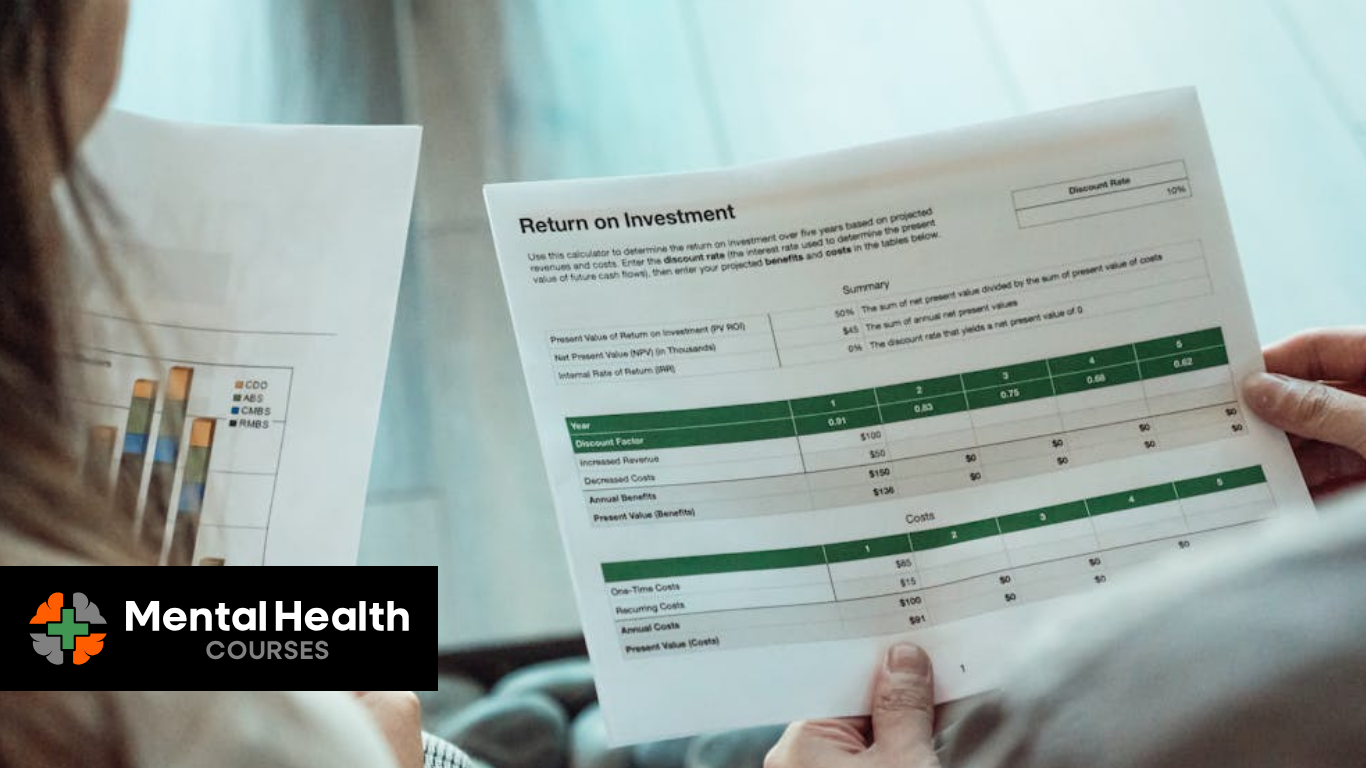
When organisations consider investing in training, one question often comes before everything else:
What is the return on investment?
This is particularly relevant when investing in mental health risk assessment training. Unlike a piece of equipment that has a clear purchase price and measurable output, the financial return from mental health training can seem harder to calculate.
But that does not mean there is no return.
Workplace mental health has a significant financial impact on UK organisations. Poor mental health can contribute to sickness absence, reduced productivity, presenteeism, employee turnover and other costs that are often less visible than a traditional health and safety incident.
At the same time, research increasingly suggests that investing in workplace mental health can generate a measurable financial return.
Deloitte’s research found that employers can receive approximately £4.70 back in improved productivity for every £1 invested in supporting employee mental health and wellbeing.

So, where does mental health risk assessment training fit into this picture?
The Financial Cost of Poor Mental Health at Work
Before looking at the return on investment, it is important to understand what organisations are potentially trying to prevent.
Mental health is not only a personal or wellbeing issue. The way work is designed, managed and organised can contribute to stress and poor mental health.
Workload, working hours, lack of control, poor support, difficult workplace relationships, unclear responsibilities and poorly managed organisational change can all create psychosocial risks.
When these risks are not identified or managed effectively, the consequences can extend beyond an individual employee.
According to Deloitte, poor employee mental health costs UK employers approximately £51 billion each year. Around £24 billion of this is associated with presenteeism, where employees are at work but are not able to perform at their full potential because of poor mental health.
That figure is important because it demonstrates that the financial cost of mental health is not limited to employees taking time off sick.
An employee does not necessarily need to be absent for their mental health to affect an organisation financially.
They may still be coming to work, attending meetings and completing tasks, while struggling to concentrate, make decisions or maintain their usual level of productivity.
This is one reason why preventative approaches matter.
Work-Related Stress Has a Significant Economic Impact
The financial case becomes even clearer when looking specifically at work-related stress.
Deloitte has reported that stress, anxiety and depression accounted for more than half of all working days lost due to work-related ill health in Great Britain in 2022/23.
Its analysis estimated the associated lost revenue at approximately £56 billion.
This demonstrates why mental health risk should not be treated solely as an employee wellbeing issue.
For employers, it can also be a productivity, workforce and health and safety issue.
The Health and Safety Executive (HSE) similarly recognises work-related stress as a health and safety risk. Its Management Standards approach focuses on six areas of work that can contribute to stress: demands, control, support, relationships, role and change.
For organisations looking to strengthen their approach to workplace mental health, understanding these factors can provide a structured starting point for identifying and managing psychosocial risks.
The Estimated ROI Of Mental Health Risk Assessment Training
The business case becomes particularly interesting when we look at what happens when organisations invest in mental health.
Deloitte’s research found that employers receive approximately £4.70 in improved productivity for every £1 they invest in supporting the mental health and wellbeing of their workforce.
Deloitte’s analysis reviewed 26 sources that reported financial returns from workplace wellbeing interventions. The research also highlighted that early interventions, including organisation-wide education and culture change, can generate higher returns than interventions introduced later when problems have already developed.
This is highly relevant when considering mental health risk assessment training.
Training alone does not magically produce a £4.70 return for every pound spent. Deloitte’s figure relates to investment in mental health and wellbeing interventions more broadly, rather than specifically to mental health risk assessment training.
However, it demonstrates something important for organisations considering whether to invest in preventative mental health measures:
There can be a substantial financial return from investing in workplace mental health rather than simply responding after problems occur.
Mental health risk assessment training can form part of that preventative approach.
Why Mental Health Risk Assessment Training Matters
Mental health risk assessment training gives the people responsible for workplace health, safety, HR and wellbeing the knowledge to identify and assess psychosocial risks.
This matters because organisations cannot effectively control a risk they have not properly identified.
Consider an organisation where employees are experiencing increasing levels of stress.
A reactive approach might begin when employees are already experiencing difficulties. Managers may start dealing with individual cases, HR may manage sickness absence, and employees may be referred to existing support services.
These interventions can be valuable, but they may not answer a more fundamental question:
What is happening in the workplace that may be contributing to the problem?
A mental health risk assessment takes the organisation further upstream.
It can help identify whether employees are facing excessive demands, insufficient control, inadequate support, difficult relationships, unclear roles or problems associated with organisational change.
Once these risks have been identified, the organisation has an opportunity to consider appropriate controls.
That is where the potential return begins.
Prevention Can Cost Less Than Reaction
Imagine that a department has experienced increasing stress-related absence.
The organisation could respond by dealing with each absence individually. However, if the underlying workplace conditions remain unchanged, the same problems may continue to affect other employees.
A risk assessment can provide another perspective.
Perhaps workloads have increased without additional resources. Perhaps employees have little control over how they organise their work. Perhaps managers have not received enough support themselves. Perhaps a period of organisational change has created uncertainty about roles and responsibilities.
Identifying these issues does not automatically solve them.
But it gives the organisation information it can use to decide what needs to change.
That is the value of mental health risk assessment training.
It helps move mental health management away from simply reacting to individual cases and towards identifying and controlling workplace risks.
Mental Health Risk Assessment Training Is an Investment in Prevention
The business case for mental health risk assessment training is ultimately about prevention.
The financial cost of poor mental health is already substantial. Deloitte’s research puts the cost to UK employers at around £51 billion a year, while its research into workplace mental health interventions found approximately £4.70 in improved productivity for every £1 invested.
For employers, this creates an important opportunity.
Rather than waiting for stress to result in absence, reduced productivity or employees leaving the organisation, businesses can take a preventative approach by identifying the workplace factors that may be creating or increasing risk.
That requires people who understand how to assess those risks effectively.
This is where mental health risk assessment training can provide value.
By developing internal knowledge and capability, organisations can make mental health risk assessment a more integrated part of their health and safety and employee wellbeing strategy.
The question is therefore not simply: “How much does mental health risk assessment training cost?”
A more useful question is: “What could unmanaged workplace mental health risks be costing our organisation, and what could we gain by identifying them earlier?”
Build Your Mental Health Risk Assessment Skills
If you are responsible for Health & Safety, HR, employee wellbeing or workplace risk management, having the right knowledge is essential for identifying and managing psychosocial risks effectively.
Our Mental Health Risk Assessment Training is designed to help professionals understand how to approach workplace mental health risk assessment in a practical and structured way, with the content closely aligned with the HSE Management Standards approach.
If you are unsure whether mental health risk assessment training is right for you, your team or your organisation, contact us, we’re happy to help you understand your training options.