
You know that workplace risk assessments are essential. You understand the importance of identifying hazards, evaluating risks and putting appropriate controls in place.
But what happens when the risk is work-related stress?
For many Health & Safety Officers, stress risk assessment can feel less straightforward than assessing physical hazards. Stress affects people differently, the causes are not always obvious, and knowing what questions to ask or what action to take can be challenging.
Yet work-related stress is a significant workplace health and safety issue. The Workforce State of Mind Report found that 49% of HR leaders had seen an increase in mental health absences. The same report found that 77% of employees said work stress had negatively affected their physical health.
Stress risk assessment is therefore about more than completing a document. It is about identifying workplace factors that may contribute to stress, evaluating the measures already in place and deciding what further action may be needed.
There is also a legal responsibility to take workplace risks seriously. Where the HSE identifies a material breach of health and safety law, its Fee for Intervention (FFI) scheme allows it to recover the costs of its intervention. As of 1 April 2026, the FFI rate is £188 per hour. The estimated cost of the investigation was at least £25,000, potentially approaching £50,000. This charge does not apply automatically whenever stress is identified; it applies where the relevant conditions for a material breach are met.
So, how can you approach stress risk assessment with greater confidence? How do you identify the relevant workplace hazards, understand your responsibilities and turn your findings into practical action?
The good news is that you do not have to figure everything out alone. With the right tool, training and support, you can build your understanding and take a structured approach to managing work-related stress risks.
Start With the HSE Management Standards
Do you know what to look for when assessing work-related stress? If you’re unsure where to start, don’t worry.
The Health and Safety Executive (HSE) provides a practical starting point: Management Standards for work-related stress.
The framework identifies six key areas of work that can contribute to stress:

These six areas help you identify potential workplace stressors and consider where action may be needed.
But knowing the framework is only the beginning. How do you apply it to your own workplace, identify who may be affected, assess existing controls and decide what needs to change?
That’s where the right tools and training can help.
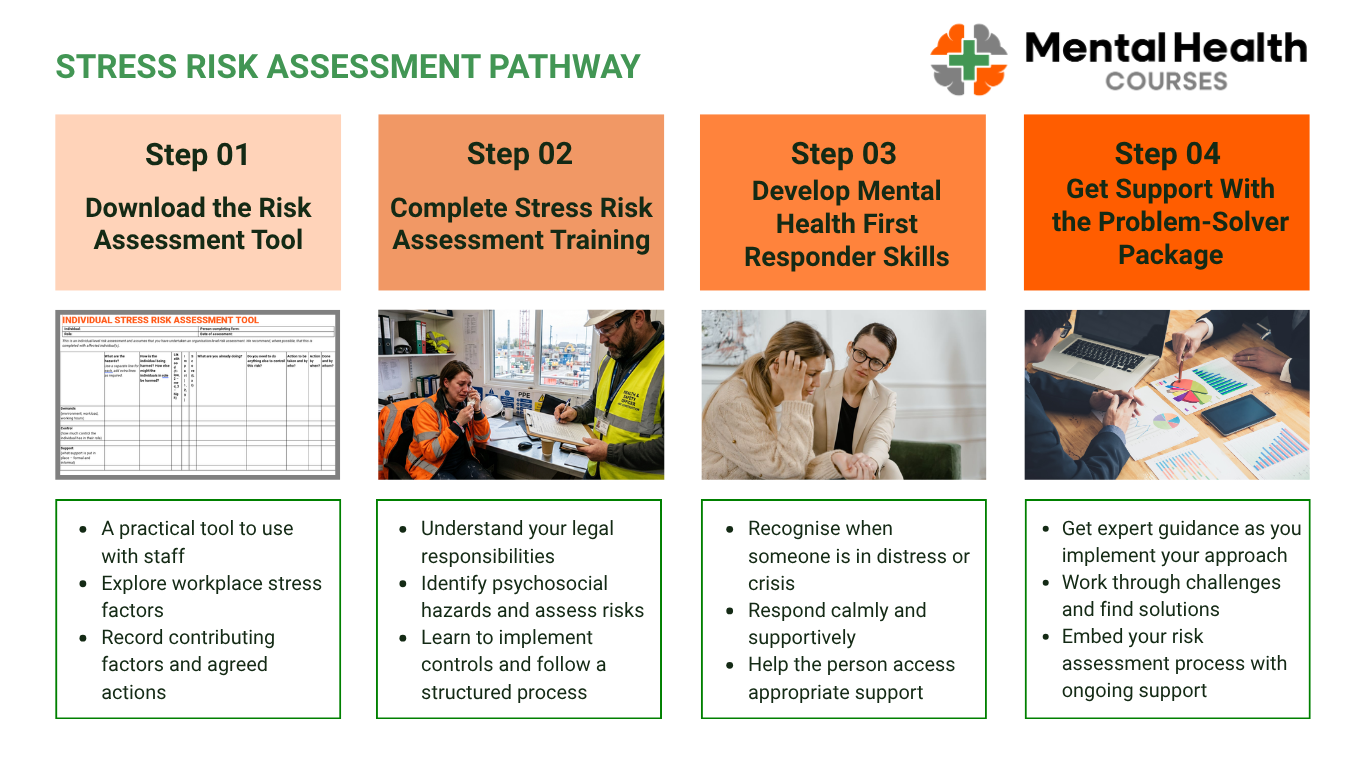
Your Stress Risk Assessment Pathway: A Practical Way Forward
If you are concerned about the cost of getting stress risk assessment wrong, the next step is to build your understanding and establish a practical way to move forward.
Our stress risk assessment pathway is designed to help you progress from an initial tool to relevant training and additional support.
Step 1: Start With the Free Individual Stress Risk Assessment Tool
Before committing to training, start by downloading our free Individual Stress Risk Assessment Tool.
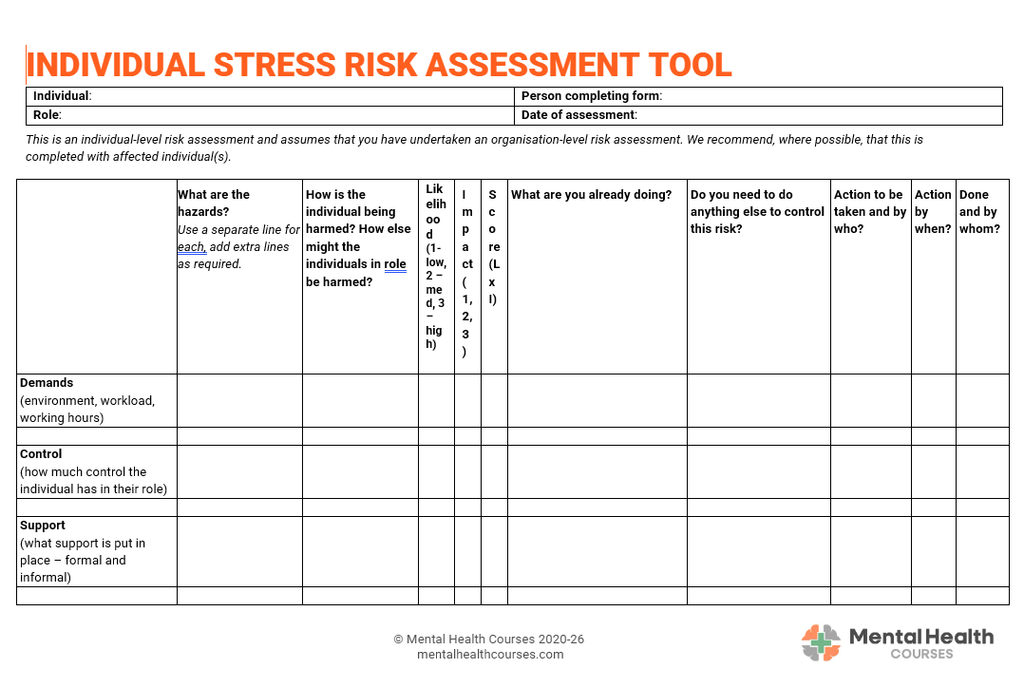
This gives you an opportunity to look at the tool, familiarise yourself with the assessment process and consider how it may relate to your workplace.
You can review it first and identify any questions you would like to explore further.
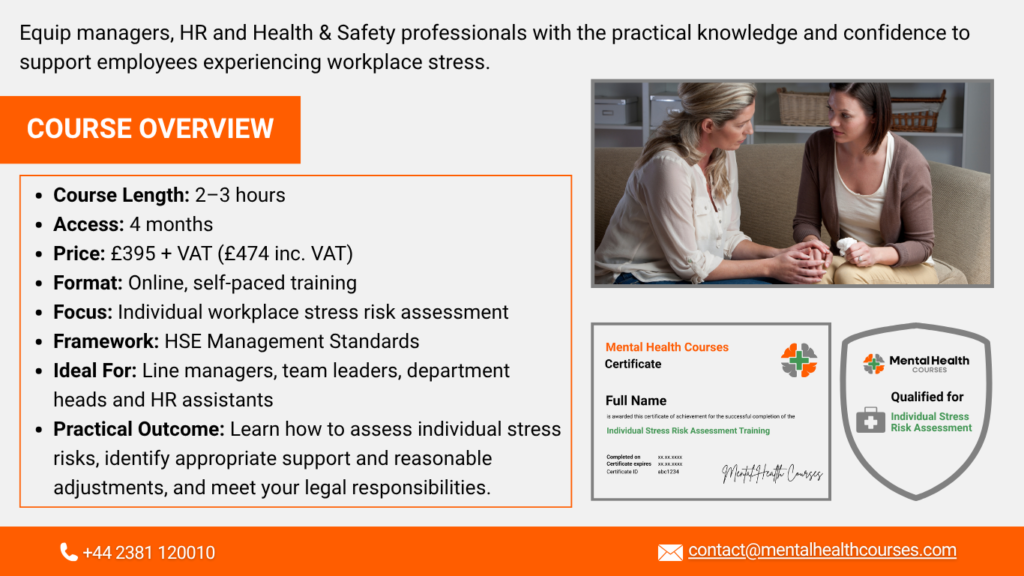
Step 2: Build Your Knowledge With Stress Risk Assessment Training
Having a tool is a useful starting point, but understanding how to approach the assessment is equally important.
Training can help you develop your understanding of workplace mental health risks, consider relevant legal responsibilities and recognise how to approach assessment and risk management in practice.
Can you recognise when something isn’t right in your workplace? Are more employees taking time off due to stress? Are people coming to work when they’re unwell, struggling to cope or showing signs of presenteeism? Are you noticing patterns that suggest workplace stress is becoming a bigger problem?
You may not have all the answers immediately, but having the right knowledge can help you recognise these warning signs, identify potential workplace risks and determine what action to take, rather than feeling out of your depth. This training could help you move beyond uncertainty and develop a clearer understanding of the steps involved.
The training also incorporates the HSE Management Standards, giving you a recognised framework to help identify workplace stressors, assess risks and determine appropriate actions.
Step 3: Develop Your Confidence in Supporting Employees with Mental Health First Responder Training
Effective workplace mental health support needs both prevention and response: identifying and managing risks wherever possible, while also knowing how to support people when they are struggling.
A stress risk assessment helps you identify and manage workplace risks before they escalate. However, even with preventative measures in place, an employee may still reach a point where they feel overwhelmed or unable to cope.
What happens when a member of staff comes to you and says, “I’m struggling to manage my workload,” or “I’m not sleeping because of work,” or “I feel overwhelmed and don’t know what to do”? Would you know how to respond, what to say and how to help them access the right support?
Mental Health First Responder training can help you develop the knowledge and skills to recognise signs of distress, approach conversations sensitively and signpost employees towards appropriate help.
Remember, Mental Health First Responder training complements stress risk assessment; it does not replace the employer’s responsibility to identify and manage workplace risks.
Step 4: Get Practical Support With the Accountability & Problem Solver Package
Sometimes, understanding the theory is not the biggest challenge. The difficult part is applying it to your own organisation.
You may have completed training but still have questions about where to start, what to prioritise or how to move from identifying a problem to taking action.
If you need help turning knowledge into action, our Accountability & Problem Solver Package offers 1:1 consultancy to help you work through your specific challenges, find practical solutions and move forward with greater confidence.
Rather than being left to figure things out alone, you’ll have practical support to help you move forward, address gaps and turn your knowledge into action.
The aim is simple: to help you carry out your stress risk assessment properly and ensure the process leads to practical, meaningful improvements in your workplace.
Prevention Takes Effort. Putting Things Right Can Take More.
Carrying out a stress risk assessment takes time. Understanding the findings, consulting employees and implementing appropriate changes also require effort.
But an inadequate assessment can leave an organisation facing additional work, investigation costs and further action to address shortcomings.
There is no universal price for getting stress risk assessment wrong. What matters is taking your responsibilities seriously, building the right knowledge and managing workplace stress risks in a structured way.
You may already have several measures in place to support employee mental health. But have you covered every stage of the stress risk assessment pathway? Take a look and identify any areas you haven’t explored yet, or where additional knowledge and support could help.
Start with the free Individual Stress Risk Assessment Tool. Explore the training appropriate for your role, and if you need help turning knowledge into action, consider our Accountability & Problem Solver Package.
The goal is not simply to complete a risk assessment. It is to identify workplace risks, take appropriate action and reduce the financial, operational and human costs of leaving problems unaddressed.
Need to get senior management on board? We can help you build the business case for mental health risk management pathway. Contact our team to request your business case and gain the support you need to move forward.
Business Case For Stress Risk Assessment Pathway