
You know that workplace risk assessments are essential. You understand the importance of identifying hazards, evaluating risks and putting appropriate controls in place.
But what happens when the risk is work-related stress?
For many Health & Safety Officers, stress risk assessment can feel less straightforward than assessing physical hazards. Stress affects people differently, the causes are not always obvious, and knowing what action to take can be challenging.
Yet failing to assess and manage workplace stress risks adequately can cost an organisation far more than the time required to carry out an assessment.
There may be investigation costs, management time, additional work, employee absence and the expense of implementing changes that could have been identified earlier.
So, how much could an inadequate stress risk assessment cost your organisation, and what can you do to reduce the risk of getting it wrong?
The Financial Cost of Getting Stress Risk Assessment Wrong
When workplace stress risks are not adequately assessed or managed, the consequences can extend well beyond the initial problem.
Consider an HSE investigation involving a Principal Inspector and colleagues over four days. The investigation included 24 focus groups and a comprehensive review of stress policies, risk assessments and sickness absence data.
Under the Fee for Intervention (FFI) scheme, the work was charged at £183 per hour. The estimated cost of the investigation was at least £25,000 and potentially close to £50,000.
That estimate did not include management time already spent or the additional time required to implement changes. Failure to act effectively could also result in further enforcement action. This example illustrates how much time, effort and money may be involved when workplace stress concerns require substantial investigation and follow-up.
It is important to note that these figures relate to the estimated cost of that particular investigation. They are not a standard fine or a fixed charge that applies to every inadequate stress risk assessment.
However, the wider lesson is clear: when stress risks are not managed effectively, putting things right can demand significant organisational resources.
The Hidden Costs: Time, Effort and Employee Absence
The financial impact is not limited to investigation costs.
There are other consequences that can place pressure on an organisation and the people responsible for managing workplace risks.
1. Management time and additional work
When concerns arise, managers and Health & Safety teams may need to gather information, review existing policies, examine risk assessments, consult employees and coordinate corrective action.
If the original assessment was inadequate, this work may be more extensive than it needed to be. Time spent responding to problems is time that could otherwise have been used to prevent risks, improve working arrangements and support employees.
2. Employee absence and disruption
Work-related stress can contribute to employee ill health and absence, potentially affecting workloads, staffing levels and continuity of work.
The Workforce State of Mind Report found that 49% of HR leaders had seen an increase in mental health absences. The same report found that 78% of employees said work stress had negatively affected their physical health.
This statistic relates to mental health absences, rather than stress-related absences alone. Nevertheless, it highlights the wider challenge organisations face in managing employee mental health. And understanding and addressing workplace risks is an important part of responding to that challenge.
3. The cost of implementing changes
When an investigation identifies shortcomings, an organisation may need to review its approach, introduce new controls, improve management practices or provide additional support and training.
Some changes may be necessary regardless of when the problem is identified. But identifying risks earlier can give an organisation a better opportunity to plan, prioritise and take action before concerns escalate.
4. The human cost
Behind every assessment is a person who may be struggling with workload, conflicting priorities, limited support, difficult relationships or uncertainty about their role.
Poorly managed work-related stress can affect employees’ wellbeing and their ability to work effectively.
A stress risk assessment should therefore be about more than avoiding costs or meeting a legal requirement. It should help an organisation understand what may be affecting its employees and what can reasonably be done to improve the situation.
Why Is Stress Risk Assessment So Difficult?
If the potential costs are significant, why do organisations find stress risk assessment challenging?
One reason is that stress is not always as easy to identify as a physical hazard.
A damaged piece of equipment can often be seen and inspected. Work-related stress may involve several contributing factors, and the same working conditions can affect employees differently.
There is no single formula that determines an acceptable level of stress for everyone. That does not mean stress cannot be assessed systematically.
The Health and Safety Executive identifies six key areas of work design that can contribute to work-related stress:

These areas provide a structure for considering potential workplace stressors.
The challenge for a Health & Safety Officer is understanding how to apply this framework, identify the relevant risks in their own workplace, evaluate existing arrangements and determine what action is needed.
You may understand the importance of risk assessment but still be unsure about what questions to ask, what evidence to consider or how to turn your findings into meaningful action.
The solution is not to avoid stress risk assessment because it feels complicated. It is to build the knowledge, tools and confidence to approach it properly.
What Does an Adequate Stress Risk Assessment Involve?
An adequate stress risk assessment should do more than demonstrate that a document exists. It should help an organisation identify potential work-related stress hazards, consider who may be affected, evaluate existing controls and determine what further action may be required. The process should lead to practical decisions, with appropriate responsibilities and follow-up.
Simply providing wellbeing resources or encouraging employees to look after themselves does not, on its own, address the workplace factors that may be contributing to stress.
For example, if excessive workload, insufficient staffing or conflicting priorities are contributing to pressure, the organisation needs to consider those working conditions and whether changes are required.
The aim is to identify and manage workplace risks, not to suggest that every instance of stress can be prevented or that every employee will respond in the same way.
For Health & Safety Officers, having a clear process can make this responsibility feel more manageable.
And you do not need to develop that process entirely on your own.
Your Stress Risk Assessment Pathway: A Practical Way Forward
If you are concerned about the cost of getting stress risk assessment wrong, the next step is to build your understanding and establish a practical way to move forward.
Our Stress Risk Assessment Pathway is designed to help you progress from an initial tool to relevant training and additional support.
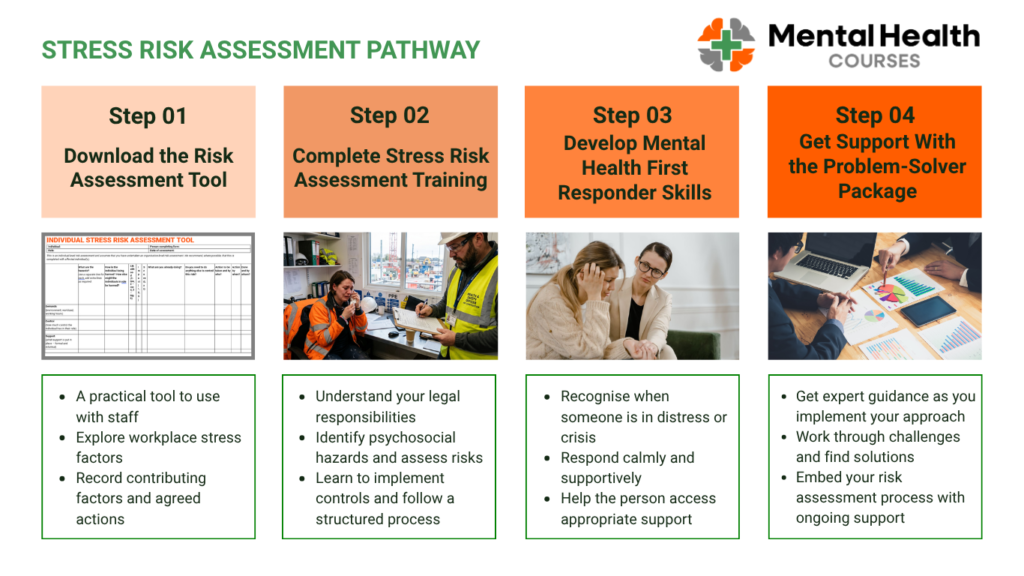
Start with these three steps:
1. Download the free Individual Stress Risk Assessment Tool. Explore the template and familiarise yourself with the assessment process.
2. Explore our Stress Risk Assessment Training. Build your understanding of workplace stress risks, the HSE Management Standards and how to approach an assessment with greater confidence.
3. Talk to us about your organisation’s needs. If you’re unsure where to start, need help applying what you’ve learned, or want to make the case for investing in stress risk assessment, get in touch. We can help you identify the most appropriate next step.
Don’t wait until workplace stress becomes a bigger problem. Start by downloading the free tool, explore the training, and contact us if you need further support.

Need to get senior management on board? We can help you build the business case for mental health risk management pathway. Contact our team to request your business case and gain the support you need to move forward.
Business Case For Stress Risk Assessment Pathway