

The Health and Safety Executive (HSE) has made reducing work-related ill health, with a specific focus on mental health and stress, one of its strategic objectives for 2026/27. Its annual KPI report also sets a target of delivering 14,000 proactive inspections across different industrial sectors between 1 April 2026 and 31 March 2027.
If you are responsible for Health & Safety, HR or Employee Wellbeing, this is an important opportunity to review your organisation’s priorities.
HSE has set its KPIs. What about yours?
If you are unsure where to start, you’re not alone. Setting meaningful workplace mental health and wellbeing KPIs requires more than counting the number of training sessions delivered or employees attending wellbeing activities. You need to understand the risks, establish measurable objectives and create a plan to achieve them.
Our Mental Health Risk Management Pathway provides a step-by-step masterplan to help you understand the risks, build your confidence and take practical action.
Why Should HSE Get Your Attention?
HSE’s 2026/27 KPI report highlights its commitment to reducing work-related ill health, particularly work-related stress and mental health difficulties.
One of its key performance indicators is to deliver 14,000 proactive inspections during the reporting year. These inspections cover a range of industrial sectors and are targeted towards areas where HSE believes it can have the greatest impact.
This does not mean all 14,000 inspections will focus on mental health. However, the inclusion of work-related ill health and mental health as a strategic objective reinforces the importance of preventing workplace harm.
And there is a financial consequence to getting things wrong.
If HSE identifies a material breach of health and safety law, an organisation may be charged under its Fee for Intervention (FFI) scheme. From 1 April 2026, the rate is £188 per hour for the time HSE spends identifying the problem and helping the organisation put things right. This can include investigation, reporting and follow-up work.
The message is clear: organisations need to be able to identify, assess and manage workplace risks proactively, including psychosocial risks and work-related stress.
So, what does this mean for your organisation?
If you are an employer, H&S Manager or HR professional, you should be asking whether your current health and safety and wellbeing strategy reflects these priorities.
You might already measure accident rates, sickness absence, staff turnover and employee engagement. But are you measuring how effectively your organisation identifies and manages psychosocial risks?
For example, do you know which workplace conditions are contributing to employee stress? Have you assessed workload pressures, management support, workplace relationships and organisational change? Are your wellbeing initiatives addressing these underlying issues?
Without clear objectives and measurable KPIs, it can be difficult to understand whether your organisation is making progress.
What Workplace Mental Health and Wellbeing KPIs Should You Set?
Setting KPIs for workplace mental health can feel less straightforward than measuring physical health and safety performance.
You might already know how to measure the number of workplace accidents or safety inspections completed. But how do you measure the effectiveness of a wellbeing initiative? How do you know whether your employees feel supported? And how can you demonstrate that your organisation is making progress in reducing workplace stress?
The first step is to understand what you want to achieve.
Here are five areas to consider when developing your workplace mental health and wellbeing KPIs.
1. KPIs for Workplace Mental Health Risk Assessments
Before introducing more wellbeing initiatives, you need to understand the risks within your organisation.
Your first objective should be to identify the psychosocial hazards that could contribute to work-related stress and assess how they affect employees.
The HSE Management Standards provide a useful framework for this, covering six key areas: Demands, Control, Support, Relationships, Role and Change.
For example, you could set a KPI to complete workplace mental health risk assessments or a mental health risk management system across all relevant departments within an agreed timeframe.
You could also monitor how many significant psychosocial risks have been identified, how many assessments have been reviewed and what proportion of identified risks have an appropriate action plan.
However, completing an assessment should not be the only measure of success. The real value comes from understanding the findings and taking action to address the risks.
Your objective should be to establish a clear picture of workplace mental health risk management and identify where improvements are needed.
2. KPIs for Mental Health Training and Management Capability
Training is often one of the first wellbeing initiatives organisations introduce. But how do you measure whether it is making a difference?
For example, you might provide mental health awareness training to employees or equip managers with the skills to recognise and respond to work-related stress.
Rather than measuring attendance alone, consider what you want participants to achieve after completing the training.
Are managers more confident having conversations about workplace stress? Do they understand how to identify potential psychosocial hazards? Can they recognise when an employee may need additional support or a workplace adjustment?
You could measure training completion rates alongside confidence assessments, knowledge checks and follow-up feedback.
This gives you a better understanding of whether your training is building the knowledge and capability your organisation needs.
3. KPIs for Employee Engagement and Wellbeing Initiatives
You may already organise wellbeing events, provide access to an Employee Assistance Programme (EAP) or encourage employees to participate in mental health awareness activities.
These initiatives can play an important role in supporting employees. However, how do you know whether employees are aware of them, engaging with them and finding them useful?
You could monitor participation rates, awareness of available support and employee feedback following wellbeing activities.
For example, if you introduce a new wellbeing programme, you might measure how many employees participate and whether they report improved awareness of the support available.
But remember, high participation does not automatically mean that workplace mental health risks are being reduced or you have completed the mental health risk management.
You should also consider whether the initiatives are relevant to the needs of your workforce and whether employees feel comfortable accessing the support provided.
Employee feedback can help you identify what is working, what needs improvement and where additional support may be required.
4. KPIs for Reducing Work-Related Stress and Improving Employee Wellbeing
Ultimately, your wellbeing initiatives should contribute to a healthier working environment and help prevent work-related ill health.
This means looking beyond the number of activities delivered and considering whether employees are experiencing improvements in their working conditions.
For example, you could monitor sickness absence related to stress, employee perceptions of workload, staff turnover and feedback on management support.
If excessive workloads are identified as a significant risk, you might introduce changes to workload distribution, staffing arrangements or management practices.
Your KPI could then measure whether employees report improvements in workload management following these interventions.
It is important to combine these outcome measures with information about what is happening within the workplace. A reduction in sickness absence alone does not necessarily mean that workplace stress has reduced, just as an increase in reported concerns does not automatically mean your initiatives are failing.
The aim is to understand the reasons behind the figures and use the findings to make informed decisions.
5. KPIs for Monitoring and Reviewing Your Mental Health Strategy
Workplace mental health is not a one-off project. Your organisation needs to regularly review its objectives, evaluate the effectiveness of its initiatives and decide what needs to happen next.
You could establish quarterly reviews to monitor progress against your KPIs, evaluate whether action plans are being completed and identify areas where additional intervention is required.
It is also important to assign responsibility for each KPI. Your H&S team, HR department, managers and senior leadership should understand their roles in delivering and reviewing your workplace mental health objectives.
This creates accountability and helps ensure that employee wellbeing remains part of your wider health and safety strategy.
How to Set Your Workplace Mental Health KPIs Before March 2027
With the 2026/27 HSE reporting year ending on 31 March 2027, now is a useful time to review your current arrangements and decide what progress you want to make before the end of the reporting period.
You do not need to introduce dozens of KPIs or launch multiple wellbeing initiatives at once.
Start by reviewing what you already have in place.
Do you have a workplace mental health risk assessment or mental health risk management system? Are your wellbeing initiatives aligned with the actual needs of your employees? Do you know which psychosocial risks need to be addressed? And do you currently have a process for monitoring the effectiveness of your interventions?
Once you understand your starting point, establish a baseline and agree on a small number of meaningful objectives.
For example, your organisation might aim to complete priority mental health risk assessments, provide relevant training for managers, implement action plans to address identified workplace stressors and introduce a regular process for reviewing employee feedback.
Make sure each KPI has a clear measure, an agreed target, a responsible owner and a review date.
It is also important to involve both HR and H&S from the beginning. Your H&S professionals can help identify and assess workplace risks, while HR teams can contribute valuable insights into employee experiences, sickness absence, engagement and organisational culture.
Working together helps ensure that your KPIs are connected to actual workplace needs rather than becoming another set of numbers to report.
Most importantly, remember that the objective is not simply to achieve your KPIs before March 2027. It is to establish a sustainable approach that continues to protect employees and improve mental health risk management beyond that date.
From Setting KPIs to Taking Action: How We Can Help
Understanding what you need to measure is one thing. Knowing how to establish an effective mental health risk management process and deliver meaningful improvements is another.
At Mental Health Courses, we help employers, H&S professionals and HR teams move from recognising workplace mental health risks to taking practical, informed action.
Our Mental Health Risk Management Pathway provides a structured approach across three connected areas:
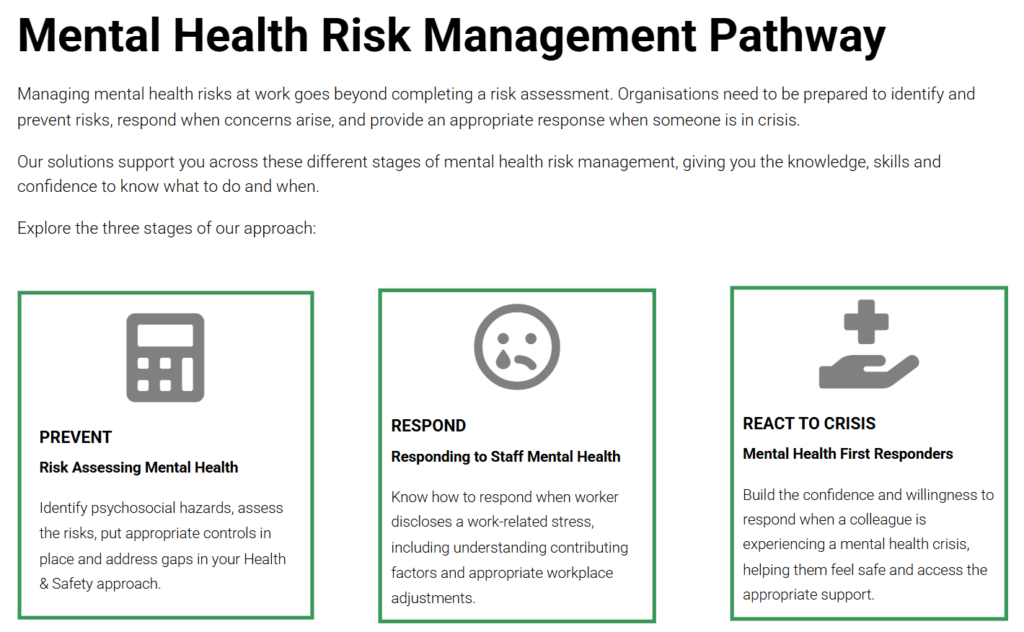
The pathway helps you look beyond individual wellbeing activities and consider the wider systems, processes and skills your organisation needs to manage workplace mental health effectively.
Whether you are starting from scratch, reviewing existing arrangements or looking to strengthen your current wellbeing strategy, we can help you understand where you are now and what needs to happen next.
Already have processes and training in place but unsure how the pathway fits into your current approach? Book a Teams call with our team to discuss your organisation’s needs and explore the right next steps.
Need to Persuade Senior Management to Invest in Mental Health Risk Management?
You may already recognise the need to improve your approach. But if you are responsible for securing senior management approval, you may need to explain why investing in workplace mental health matters to the organisation.
Our Business Case for the Mental Health Risk Management Pathway is designed to help H&S and HR professionals explain the need, organisational benefits and investment to senior stakeholders.
Download the Business Case and start building support for a more structured approach to workplace mental health.
Business Case For Mental Health Risk Management Pathway