
When you think about Health and Safety, you probably think about machinery, hazardous substances, slips, trips and falls. You identify hazards, assess risks, put controls in place and check that those controls are working.
But what about workplace factors that contribute to stress?
Are you assessing them with the same level of attention?
The Health and Safety Executive (HSE) has made reducing work-related ill health, with a specific focus on mental health and stress, one of its strategic objectives for 2026/27.
If you are responsible for Health and Safety, HR or Employee Wellbeing, now is the time to ask yourself an important question:
If an HSE inspector walked through your door tomorrow, could you demonstrate how your organisation identifies, assesses and manages the risks associated with work-related stress?
And, perhaps more importantly, are you taking action before workplace pressures begin to affect your employees’ health and your organisation’s performance?
If you’re not sure where to start, you’re not alone. Our Mental Health Risk Management Pathway provides a step-by-step masterplan to help you understand the risks, build your confidence and take practical action.
Why mental health risk assessment matters now
HSE’s Key Performance Indicators report for 2026/27 sets a target of 14,000 proactive inspections across a range of industrial sectors between 1 April 2026 and 31 March 2027.
One of the strategic objectives behind this work is to reduce work-related ill health, with a specific focus on mental health and stress.
This does not mean all 14,000 inspections will focus on mental health. However, it demonstrates that preventing work-related ill health, including stress, is an important part of HSE’s priorities.
So, here’s another question:
HSE has set its KPIs. What about yours?
Have you set clear objectives for identifying workplace factors that contribute to stress? Do you know where the risks are in your organisation? Can you demonstrate what you are doing to address them?
If mental health risk assessment is not yet part of your organisation’s systematic approach to health and safety, what is stopping you?
What if HSE knocks on your door?
Let’s consider the practical implications.
You may already have a comprehensive approach to managing physical health and safety risks. Your organisation might have established procedures, documented assessments and regular reviews.
But if an inspector asks how you assess the risks associated with work-related stress, would you be equally confident in your answer?
Could you show them the evidence?
What do your sickness absence figures tell you? Is your staff turnover higher than expected? Are there teams experiencing declining performance, more complaints or repeated reports of stress? And do you understand what might be causing these patterns?
These are not just HR statistics. They could be warning signs that something in the way work is organised is putting employees under excessive pressure.
HSE also states that employers have a legal duty to assess the risks to employees from work-related stress and act on the findings. This is part of the same responsibility to protect workers’ health that applies to other workplace risks.
A Mental Health Risk Assessment is therefore not simply a wellbeing initiative or an optional addition to your Health and Safety programme. It is an important part of managing work-related stress.
There is also a financial consideration.
HSE’s current Fee for Intervention (FFI) rate is £188 per hour. Where HSE identifies a material breach of health and safety law, it can recover the costs of identifying the breach and helping the business put matters right.
FFI is not an automatic charge for every inspection or every breach. It applies where the relevant conditions are met and HSE identifies a material breach.
Nevertheless, it is worth considering whether your organisation is confident in its approach to work-related stress and can demonstrate the steps it has taken.
The aim is not simply to avoid an inspection finding. It is to identify risks early, protect employees and take appropriate action to prevent or reduce harm.
A Mental Health Risk Assessment should therefore be more than a form completed and filed away. It should inform decisions about how work is designed, managed and supported.
But how confident are you in carrying out Mental Health Risk Assessment?
Understanding the importance of workplace mental health is one thing. Knowing how to assess and manage the risks in practice is another.
You may already have experience assessing physical hazards. You may understand the principles of risk assessment and be confident in your health and safety responsibilities.
But workplace stress and mental health risk assessment can feel less straightforward.
How do you assess something that affects people differently? How do you identify the underlying workplace factors? What evidence should you consider? How do you decide which controls are appropriate? And how do you know whether the actions you take are making a difference?
These are important questions, and you do not need to answer them through guesswork.
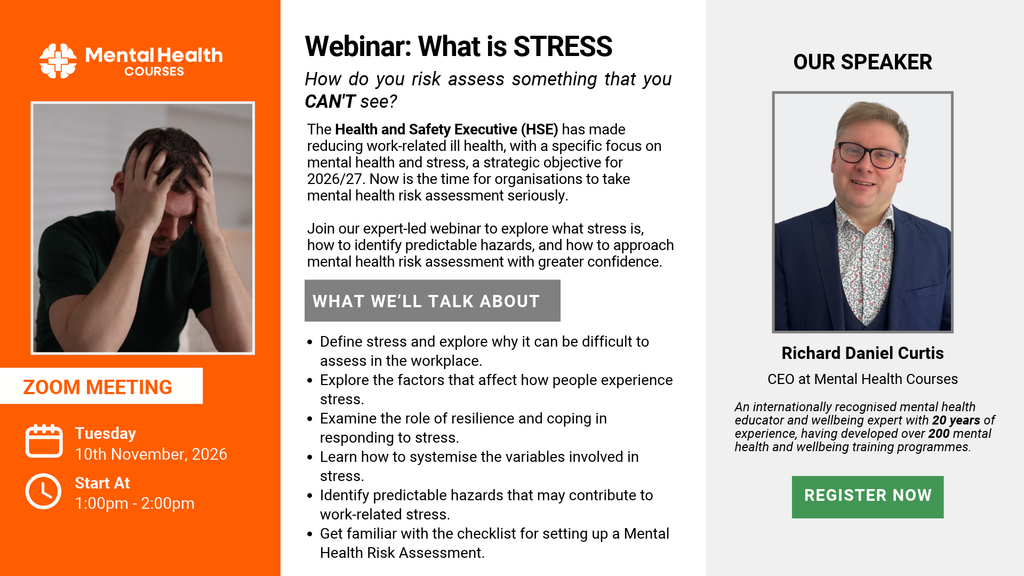
Many Health & Safety managers have come to us with these same questions. That’s why we’ve put together a webinar, “What Is Stress, and How Do You Risk Assess Something That You Can’t See?” to address these challenges, answer your questions and give you a clearer understanding of Mental Health Risk Assessment and how to approach it in your workplace.
From awareness to action: the Mental Health Risk Management Pathway
At Mental Health Courses, we help Health & Safety professionals move from understanding why workplace mental health matters to taking practical, informed steps to assess and manage workplace risks, protect employees and meet their legal responsibilities.
Our Mental Health Risk Management Pathway provides a route through three connected areas of workplace mental health:
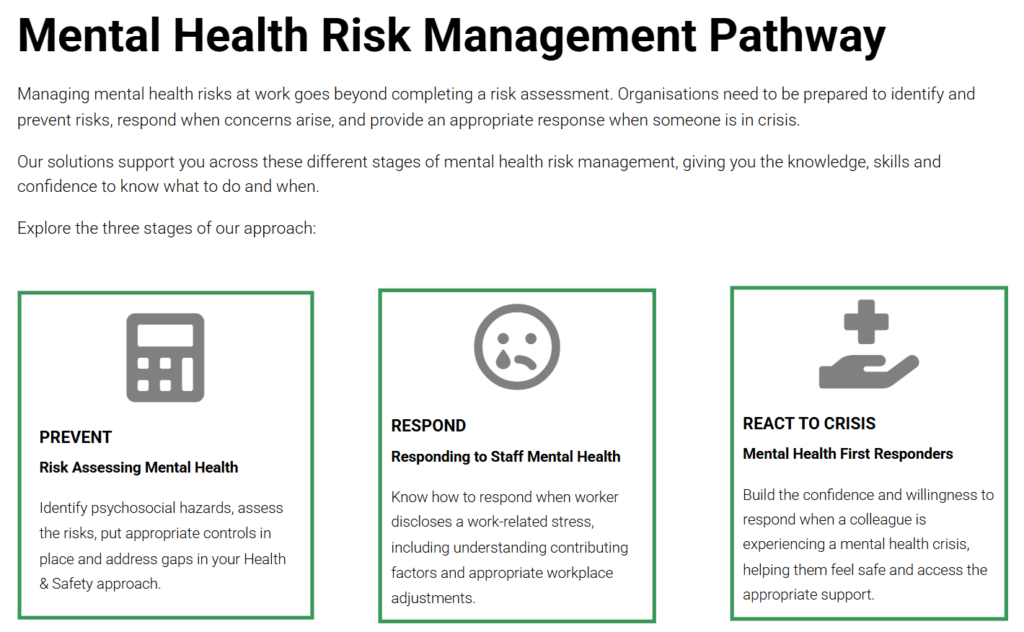
If your priority is understanding and carrying out mental health risk assessment, start with prevention. If you also need to strengthen how your organisation responds to employees experiencing difficulties, consider how the other stages can complement your approach.
Already have processes and training in place but unsure how the pathway fits into your current approach? Contact us or Book a Teams call with our team. We’d be happy to understand your organisation’s needs, discuss your current arrangements and help you explore how the pathway could work for you.
Need to persuade senior management?
You may already recognise the need to improve your approach. But if you need to secure senior management approval, you may need to explain why this investment matters to the organisation.
That means making the case for more than training alone.
Consider the potential consequences of unmanaged work-related stress: sickness absence, reduced productivity, staff turnover, recruitment and retention challenges, and the impact on colleagues who have to absorb additional workloads.
That is why we have prepared a business case for mental health risk assessment training and mental health risk management pathway. Download the business case now!
Business Case For Mental Health Risk Management Pathway