What Is a Mental Health Risk Management Pathway?
When organisations think about workplace mental health, they often start with awareness training, wellbeing initiatives or Mental Health First Aiders. These can all play a valuable role, but they do not necessarily address the full range of mental health risks an organisation needs to manage.
According to the Health and Safety Executive (HSE), 964,000 workers in Great Britain experienced work-related stress, depression or anxiety in 2024/25. These conditions accounted for an estimated 22.1 million working days lost during the same period. Source: HSE health and safety statistics 2025.
What happens when employees are consistently struggling with excessive workloads? Who is responsible for carrying out a mental health risk assessment? How should a manager respond when an employee discloses that work is affecting their mental health? And what should happen when a colleague experiences a mental health crisis?
These questions highlight why organisations need more than isolated training courses. They need a mental health risk management pathway that connects prevention, appropriate responses and crisis support.
A mental health risk management pathway provides a structured approach to managing psychosocial risks in the workplace. It helps organisations identify the factors that could harm employees’ mental health, take action to reduce those risks and equip the right people to respond when concerns arise.
For Health and Safety professionals, HR teams, wellbeing leads and senior managers, this approach helps turn mental health responsibilities into a practical process rather than leaving individuals to work out what to do as problems emerge.
Why Do Organisations Need a Mental Health Risk Management Pathway?
Workplace mental health is not simply an employee wellbeing issue. It is also a health and safety responsibility.
The UK Health and Safety Executive (HSE) states that employers have a legal duty to protect workers from work-related stress by carrying out a risk assessment and acting on the findings. This responsibility applies in the same way as the duty to assess and manage other workplace health and safety risks.
The HSE Management Standards also identifies six areas of work design associated with work-related stress: demands, control, support, relationships, role and change. Poor management of these areas can contribute to ill health, reduced productivity and increased sickness absence.
This means that providing employees with access to wellbeing resources is not necessarily enough. Organisations also need to examine whether their working conditions are creating avoidable risks in the first place.
For example, a company might offer mindfulness sessions while employees continue to experience unrealistic deadlines, unclear responsibilities or insufficient support from managers. The initiative may help individuals manage their stress, but it does not resolve the underlying workplace hazards.
A mental health risk management pathway helps organisations look at the bigger picture. It connects the identification of hazards with practical risk controls, individual support and procedures for responding to more serious situations.
It also clarifies the different responsibilities within an organisation. Health and Safety professionals may lead risk assessments, HR teams may advise on workplace adjustments and employee relations, managers may respond to individual concerns, and trained responders may provide initial support during a crisis.
When these responsibilities work together, organisations are better placed to manage mental health risks systematically.
The Three Stages of a Mental Health Risk Management Pathway
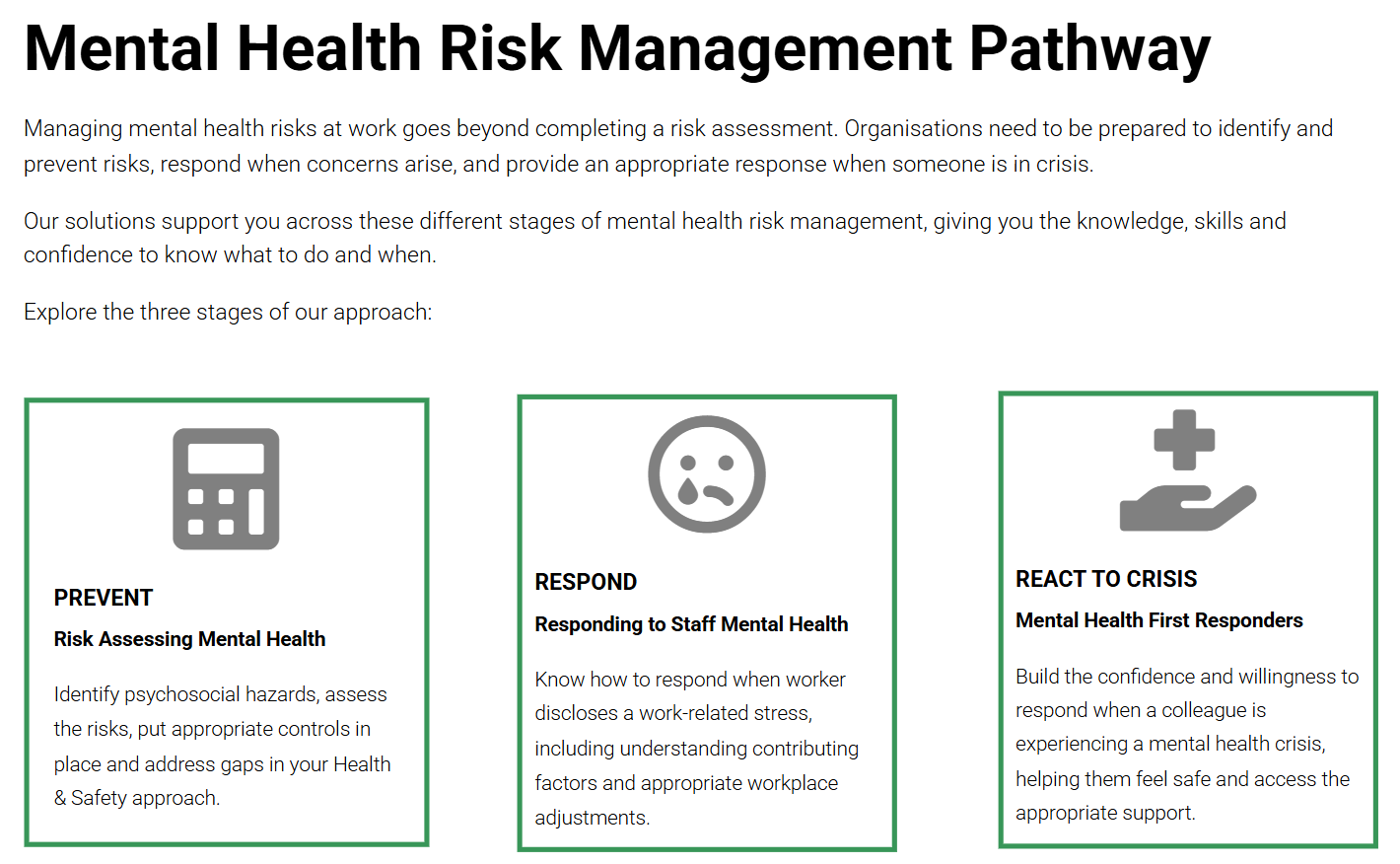
An effective mental health risk management pathway can be understood through three connected stages: Prevent, Respond and React to Crisis.
Each stage addresses a different need. Prevention focuses on reducing the likelihood of harm. Response addresses concerns when an employee is experiencing difficulties. Crisis support helps ensure that an appropriate immediate response is available when someone is in serious distress.
These stages should not operate in isolation. Together, they create a more complete approach to workplace mental health risk management.
1. Prevent: Identify and Manage Mental Health Risks Before Harm Occurs
Prevention is the foundation of a mental health risk management pathway.
Rather than waiting until employees become unwell or report work-related stress, organisations should identify the working conditions that could negatively affect their mental health and take reasonable steps to control those risks.
This requires organisations to look beyond obvious warning signs and examine how work is designed, organised and managed.
Excessive workloads, unrealistic deadlines, inadequate staffing, workplace conflict, bullying, unclear responsibilities and poorly communicated organisational changes can all contribute to psychosocial risk. The specific hazards will vary between organisations, departments and roles.
The HSE Management Standards provide a useful framework for examining these risks. They cover demands, control, support, relationships, role and change, helping employers identify the underlying workplace factors that may contribute to stress.
A suitable mental health risk assessment should identify the relevant hazards, consider who might be harmed and how, evaluate the existing controls, and determine what further action is needed.
Importantly, the process should involve employees. Staff members often have the clearest understanding of the pressures they experience in their roles and can help identify practical improvements that management might otherwise overlook.
Once the assessment is complete, organisations need to implement and review their action plans. Depending on the findings, this could involve adjusting workloads, improving communication, clarifying responsibilities, strengthening management support or addressing workplace conflict.
Training is essential to making this process effective. Health and Safety professionals, HR teams and other responsible staff need to understand how to identify psychosocial hazards, assess risks and implement appropriate controls.
Our Risk Assessing Mental Health training & packages are designed to help organisations develop this capability. It focuses on understanding mental health hazards, categorising risks, identifying existing controls and addressing gaps in the organisation’s approach.
By strengthening prevention, organisations can move away from relying solely on reactive wellbeing initiatives and towards managing the workplace factors that may contribute to poor mental health.
2. Respond: Know What to Do When an Employee Raises a Concern
Even organisations with effective preventative measures will sometimes encounter situations where an employee experiences work-related stress or mental health difficulties.
A member of staff might approach their manager because their workload has become unmanageable. Another employee might disclose that a recent organisational change is affecting their wellbeing. Someone else may have returned from sickness absence and need adjustments to help them work safely and sustainably.
These situations require an appropriate, consistent and supportive response.
However, managers and HR professionals may feel uncertain about what to ask, how to identify work-related contributing factors or how to agree practical next steps. Some may worry about saying the wrong thing, while others may focus on the employee’s symptoms without examining the working conditions contributing to the problem.
A structured response process can help address these challenges.
Where appropriate, an individual stress risk assessment can provide a framework for discussing the employee’s concerns, identifying work-related stressors and agreeing measures to reduce the risks. This might include reviewing workload, adjusting deadlines, clarifying priorities, improving access to support or considering reasonable workplace adjustments.
The conversation should involve the employee and focus on understanding their circumstances rather than making assumptions about their mental health.
It is also important to distinguish between managing workplace risks and providing clinical care. Managers are not expected to diagnose mental health conditions. Their role is to listen, identify relevant workplace issues, follow organisational procedures and help the employee access appropriate support when necessary.
The agreed actions should be recorded where appropriate, communicated to the relevant people and reviewed to establish whether they are working.
Training can help managers, HR professionals and other responsible staff approach these conversations with greater confidence. It can also help organisations establish clearer processes for handling disclosures and individual stress risk assessments.
Our Responding to staff mental health resources and training include tools for responding to staff mental health concerns and understanding individual stress risk assessments.
This stage connects prevention with practical action. It ensures that when an employee raises a concern, the organisation has a process for understanding the problem, agreeing appropriate measures and following through.
3. React to Crisis: Prepare People to Provide Immediate Support
The third stage of a mental health risk management pathway is preparing for situations in which an employee experiences a mental health crisis or severe distress.
Although prevention and early intervention are essential, organisations should also consider how they will respond when someone needs immediate support.
A colleague might become overwhelmed at work, experience an acute mental health crisis or disclose something that raises immediate concerns about their safety. In these situations, people nearby need to know how to respond calmly, recognise when additional help is needed and follow the organisation’s procedures.
This is where Mental Health First Responders can play an important role.
Mental Health First Responders receive training to provide initial support during a crisis, help the person feel safer and guide them towards appropriate assistance. They can form part of an organisation’s wider arrangements for responding to mental health emergencies.
However, crisis response should not be confused with prevention. Having trained responders does not remove the need to assess workplace stress risks, address harmful working conditions or respond appropriately when employees report difficulties.
Similarly, a trained responder is not a substitute for emergency services or qualified healthcare professionals when these are required.
Organisations should establish clear boundaries, escalation procedures and access to appropriate support so that trained colleagues understand what they can do, what they should not attempt to do and when to seek further help.
Our Mental Health First Responder training can help organisations develop this element of their mental health risk management pathway.
By preparing people to provide initial support, organisations can strengthen their response arrangements while maintaining a clear focus on prevention and early intervention.
How Do the Three Stages Work Together?
The real value of a mental health risk management pathway comes from connecting the three stages.
Consider an organisation where employees are experiencing increasing pressure because of staffing shortages and changing priorities.
At the prevention stage, the organisation identifies excessive demands and unclear communication as significant psychosocial hazards. It reviews workloads, consults employees and introduces practical controls.
Despite these measures, an employee tells their manager that they are struggling to cope. At the response stage, the manager discusses the employee’s concerns, considers the contributing work factors and agrees appropriate adjustments and follow-up arrangements.
If the employee or another colleague subsequently experiences a serious mental health crisis, trained responders and established escalation procedures help ensure that appropriate immediate support is provided.
The example illustrates why a single intervention cannot address every aspect of mental health risk management.
A risk assessment alone cannot guarantee that managers know how to respond to an individual disclosure. A manager training course does not necessarily establish the organisation’s crisis response arrangements. And crisis training does not remove the underlying hazards that may contribute to workplace stress.
Each stage has a distinct purpose, but they are most effective when supported by clear responsibilities, suitable procedures and ongoing review.
Who Should Be Involved in a Mental Health Risk Management Pathway?
Mental health risk management is rarely the responsibility of one person or department.
Health and Safety professionals may be responsible for coordinating risk assessments and ensuring that psychosocial hazards are considered alongside other workplace risks. They need the knowledge and confidence to identify relevant hazards, evaluate existing controls and work with other departments to implement improvements.
HR professionals often play an important role in employee relations, workplace adjustments, sickness absence management and supporting managers when individual concerns arise.
Line managers are particularly important because they work closely with employees and may be the first people to notice changes in behaviour, workload pressures or signs that someone is struggling. They need to understand how to have supportive conversations, follow internal procedures and escalate concerns appropriately.
Wellbeing teams can help connect the pathway with wider employee support initiatives, while senior leaders need to provide the resources, accountability and organisational commitment required to make improvements happen.
The exact responsibilities will depend on the organisation’s size, structure and existing arrangements. Smaller businesses may need individuals to take on several roles, whereas larger organisations may have dedicated Health and Safety, HR, occupational health and wellbeing teams.
The important point is that everyone involved understands their responsibilities and knows when to involve someone else.
How Can You Implement a Mental Health Risk Management Pathway?
The best starting point is to understand what your organisation already has in place and where the gaps are.

Begin by reviewing your existing risk assessment arrangements. Do they explicitly consider psychosocial hazards and work-related stress? Are employees consulted about the factors affecting their mental health? Are identified risks translated into practical action plans, and are those actions reviewed?
Next, examine what happens when an employee raises a concern. Do managers know how to respond? Is there a suitable process for individual stress risk assessments? Are responsibilities for agreeing, recording and reviewing workplace adjustments clear?
Finally, consider your crisis response arrangements. Do relevant employees know how to access immediate support? Are trained responders available where appropriate? Do people understand the limits of their role and the procedures for escalating serious concerns?
This review will help you identify which training and organisational improvements should take priority.
For some organisations, the main gap will be the ability to conduct a suitable mental health risk assessment. Others may already have an established assessment process but need to improve how managers respond to employees experiencing work-related stress. Some may need to strengthen their crisis response arrangements.
There is no need to assume that every organisation must implement every intervention at once. The aim is to build a proportionate pathway that reflects the risks, responsibilities and resources of your workplace.
Training should support this process rather than become an end in itself. The objective is not simply to increase the number of people who have completed a course. It is to ensure that the right people have the knowledge and practical skills to fulfil their responsibilities.
Why Choose Mental Health Courses for Your Mental Health Risk Management Pathway?
At Mental Health Courses, we recognise that managing mental health at work involves more than raising awareness. Organisations need practical knowledge, tailored resources and the right skills to identify risks, respond to concerns and provide appropriate support.
Our Health and Safety mental health offering brings together training and consultancy services that support the different stages of the mental health risk management pathway, from prevention and risk assessment to responding to staff concerns and managing mental health crises.
We understand that every organisation is different. That is why we tailor supplementary books and learning resources to each organisation, helping ensure that the training is relevant to your business, workplace challenges and specific requirements. Rather than taking a one-size-fits-all approach, we aim to provide practical guidance that your people can apply in their day-to-day roles.
We also stand behind the value of our services with a money-back guarantee on our training and consultancy services. If the service does not work for your business, we will give your money back, giving you greater confidence when investing in your organisation’s mental health risk management.
Whether you are a Health and Safety professional looking to strengthen your risk assessment process, an HR professional supporting employees experiencing work-related stress, or an organisation seeking to improve its crisis response arrangements, we can help you identify the most appropriate next step.
Our approach includes Risk Assessing Mental Health training, support for responding to staff mental health concerns and Mental Health First Responder training. You can explore the options that best fit your existing provision and requirements, with resources tailored to help make your investment practical and relevant.
You do not have to work everything out alone. If you are unsure where to begin, our team can help you understand your current position and identify the training or consultancy support that may be right for your organisation.
Ready to build a mental health risk management pathway that works for your business?
Explore our Health and Safety Mental Health Hub to discover our training and consultancy services, or contact our team to discuss your organisation’s needs.
Build Your Mental Health Risk Management Pathway Today
Managing workplace mental health effectively requires a joined-up approach. Organisations need to identify and control psychosocial hazards, respond appropriately when employees experience difficulties and prepare people to provide initial support during a crisis.
A mental health risk management pathway brings these responsibilities together in a practical framework.
For employers, Health and Safety teams, HR professionals and wellbeing leads, the first step is to identify what is already working, understand where the gaps are and equip the right people with the skills to address them.
You do not need to solve every challenge at once. You do need a clear understanding of your responsibilities and a practical plan for meeting them.
Ready to strengthen your organisation’s approach to mental health risk management?
Visit our Health and Safety Mental Health Hub to explore our training and resources, or contact our team to discuss which stage of the pathway is right for your organisation.
Need to get senior management on board? We can help you build the business case for mental health risk management pathway. Contact our team to request your business case and gain the support you need to move forward.
Business Case For Mental Health Risk Management Pathway