

For many years, workplace health and safety focused almost exclusively on physical hazards. Slips, trips, manual handling and hazardous substances all remain essential areas of risk management, but today’s workplaces present another equally important challenge: work-related stress.
Workplace stress is no longer viewed as simply a personal issue or an unavoidable part of modern working life. Research from IOSH continues to demonstrate that prolonged workplace stress can have significant effects on both physical and psychological health, influencing decision-making, concentration, behaviour and overall workplace safety. As organisations place greater emphasis on employee wellbeing, safety professionals have an increasingly important role in identifying and managing psychosocial risks before they cause harm.
Understanding the Difference Between Pressure and Stress
Stress is the body’s natural response to pressure or demand. In the short term, a moderate level of pressure can actually improve performance by increasing focus, motivation and alertness. This positive form of stress, often referred to as eustress, helps people meet deadlines, solve problems and respond effectively during challenging situations.
Problems arise when pressure becomes excessive or prolonged. Unlike short-term stress, chronic stress keeps the body’s stress response activated for extended periods, preventing adequate recovery. Instead of improving performance, it gradually begins to reduce it.

Scientific research has shown that long-term stress can affect several important areas of the brain. The hippocampus, responsible for learning and memory, may become less effective. The prefrontal cortex, which supports decision-making, planning and concentration, can become impaired, while the amygdala, responsible for emotional responses, becomes increasingly reactive. These neurological changes help explain why employees experiencing prolonged stress often struggle with concentration, make more mistakes, experience heightened anxiety and may ultimately develop burnout or depression.
For safety professionals, these changes are particularly significant because they directly influence the likelihood of human error and workplace incidents.
Why Workplace Stress Has Become a Safety Issue
Work-related stress is now recognised as one of the leading causes of occupational ill health across the UK. According to the Health and Safety Executive (HSE), stress, depression and anxiety continue to account for a substantial proportion of work-related illness and millions of working days lost each year.
The consequences extend far beyond employee wellbeing. Persistent stress can reduce productivity, increase sickness absence and contribute to higher staff turnover. Employees experiencing excessive workplace stress are also more likely to make mistakes, overlook hazards or experience lapses in judgement, increasing the risk of accidents and near misses.
These wider organisational impacts demonstrate why workplace stress should be treated like any other workplace hazard. If unmanaged, it presents operational, financial and legal risks alongside its human cost.
Recognising Common Sources of Workplace Stress
Rarely does workplace stress stem from a single issue. More often, it develops through a combination of organisational factors that gradually overwhelm an employee’s ability to cope.
Excessive workloads, unrealistic deadlines and long working hours remain some of the most common causes. Employees may also experience workplace stress when they have little control over how they carry out their work, receive unclear instructions or lack adequate management support.
Organisational change can create uncertainty, particularly where communication is poor or job security is questioned. Interpersonal issues, including bullying, harassment and workplace conflict, can further increase psychological pressure. Even when individual stressors appear manageable in isolation, their combined effect can become significant over time.
Understanding these underlying causes allows Health & Safety officers to focus on prevention rather than simply responding once employees reach crisis point.
Why Employers Cannot Ignore Workplace Stress Risks
Although stress affects individuals differently, employers have clear legal responsibilities to manage foreseeable risks arising from work.
The Health and Safety at Work etc. Act 1974 places a duty on employers to protect the health, safety and welfare of employees, while the Management of Health and Safety at Work Regulations 1999 require suitable and sufficient risk assessments that include psychosocial hazards where relevant.
The HSE’s Management Standards for Work-Related Stress provide practical guidance for assessing and controlling six key areas that commonly contribute to workplace stress, including workload demands, control, support, relationships, role clarity and organisational change.
Other legislation may also apply. Under the Equality Act 2010, employees whose stress contributes to a long-term mental health condition may be protected from discrimination, while the Working Time Regulations 1998 help address excessive working hours and inadequate rest.
Where employers ignore known workplace stress risks, fail to investigate concerns or neglect appropriate risk assessments, they may face enforcement action, civil claims and significant reputational damage.
Where the Responsibility of Safety Professionals Begins and Ends
Health & Safety officers play an important role in helping organisations manage psychosocial risks, but they are not personally responsible for every case of workplace stress.
Their responsibility is to ensure suitable systems are in place, risks are assessed appropriately and concerns are escalated when identified. Where employers have implemented appropriate policies, carried out suitable assessments and provided reasonable support, they have generally met their legal obligations.
Equally, stress may sometimes arise primarily from personal circumstances outside work. While employers should still offer appropriate support wherever possible, they cannot reasonably control every external factor affecting an individual’s wellbeing.
The objective is therefore not to eliminate all stress, but to reduce work-related risks so far as is reasonably practicable.
Moving from Reactive to Preventative Risk Management
Managing workplace stress effectively requires the same systematic approach used for physical hazards. Rather than waiting until employees become unwell, organisations should actively identify emerging risks before they develop into long-term problems.
Regular stress risk assessments should form part of wider health and safety management systems, supported by open communication between employees and managers. Line managers should receive training to recognise early warning signs, including changes in behaviour, declining performance, increased absence or withdrawal from colleagues.
Workloads should be reviewed regularly to ensure expectations remain realistic, while employees should understand both their responsibilities and the support available to them. Access to occupational health, employee assistance programmes and flexible working arrangements can all contribute to reducing unnecessary pressure.
Creating psychologically safe workplaces where employees feel comfortable discussing concerns is often one of the most effective preventative measures an organisation can implement.
When Individual Stress Risk Assessments Are Needed
While organisational assessments help identify broader workplace risks, there are occasions when an individual employee requires additional support.
An Individual Stress Risk Assessment provides a structured opportunity to explore both workplace and personal factors contributing to stress. Rather than simply recording concerns, it enables employers and employees to agree practical adjustments that may reduce risk, such as temporary workload changes, flexible working arrangements or additional managerial support.

Importantly, these assessments also demonstrate that concerns have been taken seriously and that appropriate steps have been considered, providing valuable evidence of due diligence should issues escalate later.
Responding When an Employee Says They Are Struggling
One of the biggest mistakes organisations make is dismissing stress as simply part of the job.
When an employee reports feeling overwhelmed, the response should be timely, supportive and focused on understanding the underlying causes. Confidential discussions should explore both work-related pressures and any adjustments that could reduce immediate risks.
Any agreed actions should be documented and reviewed regularly to ensure they remain effective. Where appropriate, HR, occupational health or specialist support services should also become involved to provide additional expertise.
Early intervention is almost always more effective than waiting until an employee requires prolonged sickness absence.
Safety Professionals Need Support Too
Health and safety professionals frequently carry significant responsibility while balancing competing operational demands. Managing incidents, investigations, audits, inspections and legal compliance can itself become a source of considerable stress.
Maintaining personal wellbeing is therefore essential. Setting realistic boundaries, seeking peer support and keeping knowledge up to date through professional development all help safety professionals remain effective while reducing their own risk of burnout.
Investing in Wellbeing Benefits Everyone
Creating healthier workplaces is no longer simply about meeting legal obligations. Organisations that actively support employee wellbeing often experience improved engagement, stronger retention, lower sickness absence and a more resilient workforce.
When workplace stress is managed effectively, employees are better able to concentrate, make sound decisions and work safely. The result is not only healthier people but also stronger organisational performance.
Learn How to Manage Mental Health Risks with Confidence
Understanding workplace stress is only the first step. The real challenge is knowing how to identify psychosocial hazards, assess the risks and put effective control measures in place before issues escalate.
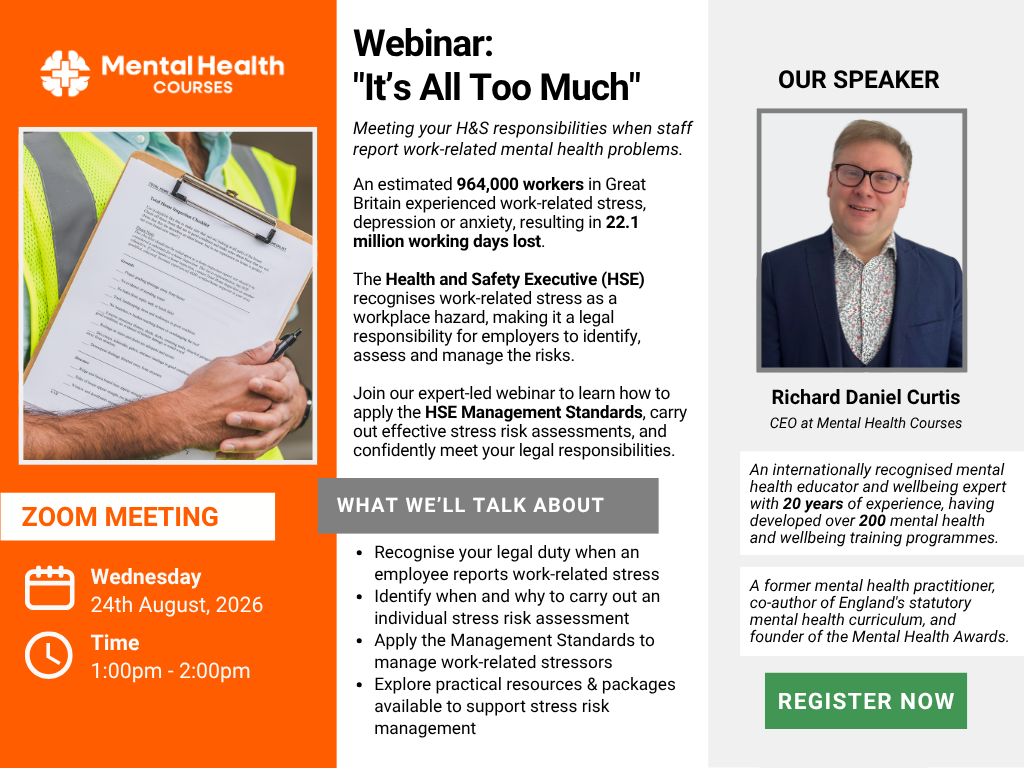
Our It’s All Too Much: Meeting your H&S responsibilities when staff report work-related mental health problems webinar explains the legal responsibilities employers have under UK health and safety law, shows you how to recognise common psychosocial hazards, and demonstrates how to carry out effective Workplace Stress Risk Assessments and Individual Stress Risk Assessments. Through practical examples and expert guidance, you’ll gain the confidence to manage mental health risks proactively and create a healthier, safer and more resilient workplace.
📅 Monday, 24 August 2026
🕐 1:00–2:00pm (BST)
💻 Live on Zoom
Whether you’re a Health and Safety Officer, manager or employer, you’ll leave with practical knowledge and tools that you can apply immediately within your organisation.
If you’re looking for ongoing support, resources and expert guidance beyond the webinar, explore the Health & Safety Mental Health Hub, your central resource for building a mentally healthy workplace with confidence.