
Struggling to engage employees with workplace mental health support? We can help you develop a comprehensive, structured masterplan to improve employee mental health. Explore our stress risk assessment pathway to understand where to start, or book a consultancy meeting with us to discuss a tailored approach for your organisation.
Many organisations have invested in workplace mental health support, including Employee Assistance Programmes (EAPs), wellbeing apps and mental health training. Yet, despite these efforts, many employees remain reluctant to seek help.
According to a survey of 2,010 UK employees reported by HR Magazine in October 2026, 91% of employees have access to workplace mental health support, but only 37% say they would use it.
This raises an important question for employers: if workplace mental health support is already in place, why aren’t more employees willing to access it?
The answer may lie not in the availability of support, but in the workplace culture, management practices and underlying risks that influence whether employees feel able to ask for help.
Why aren’t employees using workplace mental health support?
The survey highlights several barriers. Around 32% of employees worry that accessing mental health support could affect their career or job security, while 29% feel embarrassed about asking for help. A further 23% believe their problems are not serious enough to warrant support.
These findings reveal that employees may face more than a lack of awareness. Even when they know where to find help, they may fear being judged, worry about how their manager will react or believe they should be able to cope on their own.
Workplace culture can reinforce these concerns. If employees see colleagues working under excessive pressure without support, or managers dismissing concerns about stress, they may conclude that admitting they are struggling could harm their professional reputation.
Others may wait until their mental health deteriorates significantly before seeking help because they associate support with crisis rather than prevention.
Simply promoting an EAP or introducing another wellbeing initiative will not necessarily overcome these barriers. Employers must also create an environment where employees feel safe speaking up and confident that their concerns will be taken seriously.
Why providing more support isn’t always the answer
When employees underuse workplace mental health support, organisations may respond by investing in more resources or running additional awareness campaigns. While these initiatives can be valuable, they do not automatically address the reasons employees are struggling.
For example, counselling may help an employee manage stress, but it will not resolve an excessive workload or unclear responsibilities. A wellbeing app cannot compensate for a manager who fails to respond appropriately to concerns. And a mental health awareness campaign will have limited impact if employees still fear negative consequences for asking for help.
This is why employers need to look beyond the support they provide and consider the workplace conditions contributing to poor mental health.
Work-related stress can be associated with factors such as excessive demands, limited control, insufficient support, difficult workplace relationships and unclear roles. Identifying these risks allows organisations to consider whether changes to working practices, management approaches or existing controls are needed.
The aim is not to replace current workplace mental health support, but to complement them with a more proactive approach that addresses problems at their source.
How can employers improve workplace mental health support?
A more effective workplace mental health support strategy combines accessible support with early intervention and appropriate risk management.
Managers need to feel confident starting conversations about mental health, recognising potential signs of stress and responding appropriately when employees raise concerns. They should understand how to listen without judgement, explain available support and signpost employees to suitable resources.
At the same time, employers need a structured way to identify and assess work-related stress risks. This helps them move beyond individual conversations and consider whether wider workplace factors are affecting teams or groups of employees.
For organisations unsure where to start, the Stress Risk Assessment Pathway from Mental Health Courses offers a practical place to explore the process of managing workplace stress risks.
Start with the Stress Risk Assessment Pathway
Understanding how to approach stress risk assessment can help organisations turn their commitment to mental health into practical action.
The Stress Risk Assessment Pathway can help guide your next steps:
Step 1: Understand the pathway. Explore the Stress Risk Assessment Pathway to understand the stages involved in managing work-related stress.
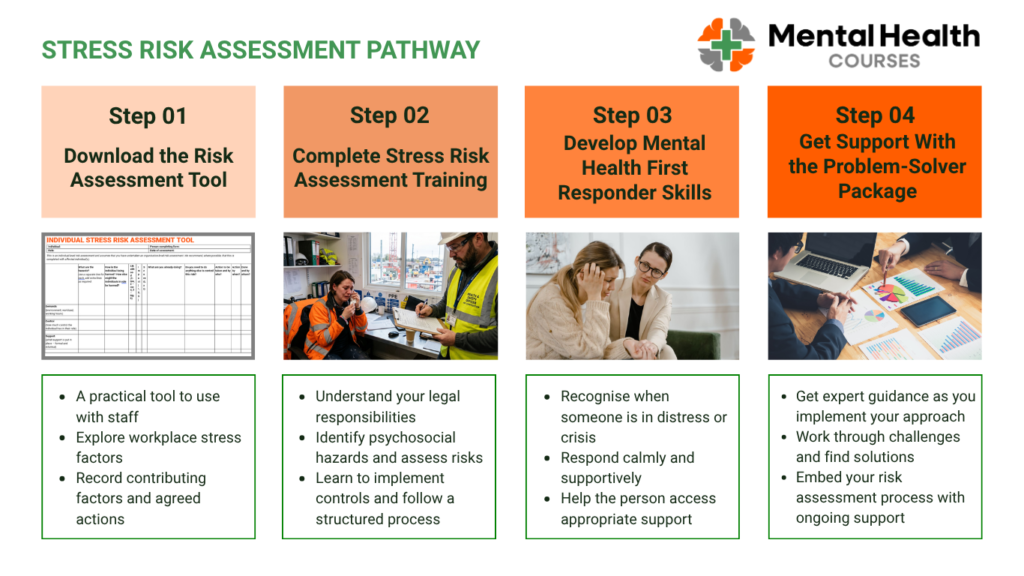
Step 2: Build your skills. Develop your understanding of how to start conversations with employees about stress, recognise potential warning signs and respond to concerns appropriately.
Step 3: Identify and assess risks. Consider the workplace factors that may be contributing to stress and how existing measures can be evaluated.
Step 4: Plan your actions. Use the assessment process to identify priorities, strengthen controls and determine what changes may be needed to improve employee wellbeing.
By following a structured approach, employers can better understand where risks exist and what action may be required, rather than relying solely on support services after problems arise.
Make workplace mental health support work in practice
The gap between employees having access to mental health support and feeling comfortable using it highlights an important challenge for organisations. Providing resources is only part of the solution; employees also need to feel safe asking for help, while employers must be willing to address the working conditions that contribute to poor mental health.
A proactive approach brings these elements together: supportive workplace culture, confident managers, accessible services and effective stress risk assessment.
The question is not simply whether mental health support is available, but whether employees feel able to use it and whether the organisation is addressing the risks that make support necessary.
Ready to take the next step? Explore the Stress Risk Assessment Pathway to help you understand how to approach workplace stress risk assessment and build a more proactive mental health strategy.
Any questions & enquiries? We’re here to help you go through and shape a better workplace mental health support for your staff.